India draws on groundwater for farms, homes, factories and entire cities. The national numbers look stable. The local picture often does not.
Extraction is balanced nationally, stressed locally
The 2025 Dynamic Ground Water Resources Assessment, prepared by the Central Ground Water Board (CGWB) with state governments, put India's annual groundwater recharge at 448.52 billion cubic meters (BCM). Annual extraction for all uses was 247.22 BCM. That gives a national stage of extraction of 60.63%.
The average hides the pressure points. Of the 6,762 blocks, mandals and talukas assessed, 730 (10.8%) are over-exploited, where pumping exceeds annual recharge. Another 201 (2.97%) are critical and 758 (11.21%) are semi-critical, according to the same assessment. A site in a stressed unit faces different supply, recharge and approval questions than a site a few kilometers away.
Read the Ministry of Jal Shakti summary of the 2025 groundwater assessment.
The rock under the city changes the rules
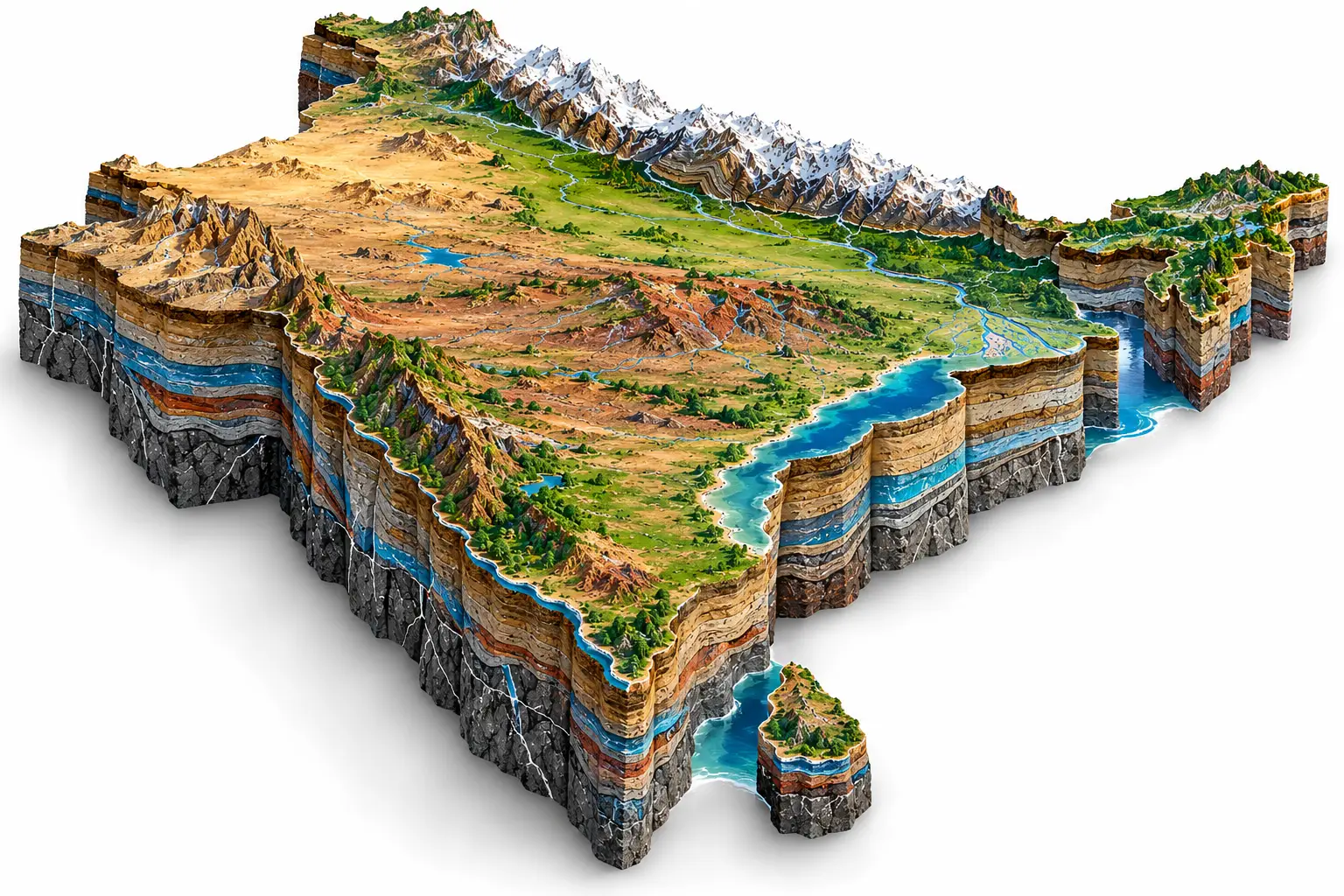
CGWB classifies India's groundwater-bearing formations into 14 principal aquifer systems and 42 major aquifers. Alluvium, gneiss and basalt represent different settings for groundwater storage and movement. In hard-rock terrain, groundwater is held mainly in weathered and fractured zones, so conditions can change over short distances.
Ministry of Jal Shakti: principal and major aquifer systems.
Rain arrives in one season
IMD's 1971–2020 rainfall normal is 1,160.1 mm annually, including 868.6 mm during the southwest monsoon. Rainfall is much higher in Konkan and Goa than in West Rajasthan. The timing and intensity of rain shape seasonal water-table responses, recharge opportunities, seepage and flood exposure.
Water quality is a site-level question
CGWB's Annual Ground Water Quality Report 2024 draws on 15,259 monitoring locations. Among the samples tested for each parameter, 19.8% exceeded the nitrate limit, 9.04% the fluoride limit and 3.1% the arsenic limit. These monitoring results describe regional variation; they do not establish the quality of water at a particular site.
Read the Ministry of Jal Shakti summary of CGWB's Annual Groundwater Quality Report 2024.
What this means for your project
- A national or state average tells you little about your plot.
- Aquifer type controls yield, recharge potential and how contaminants move.
- Seasonal rainfall drives water table swings that affect basements, excavations and drainage.
- Quality varies by geology and land use, so testing and monitoring need a site-specific plan.