 (+035) 527-1710-70
 NEWSLETTER


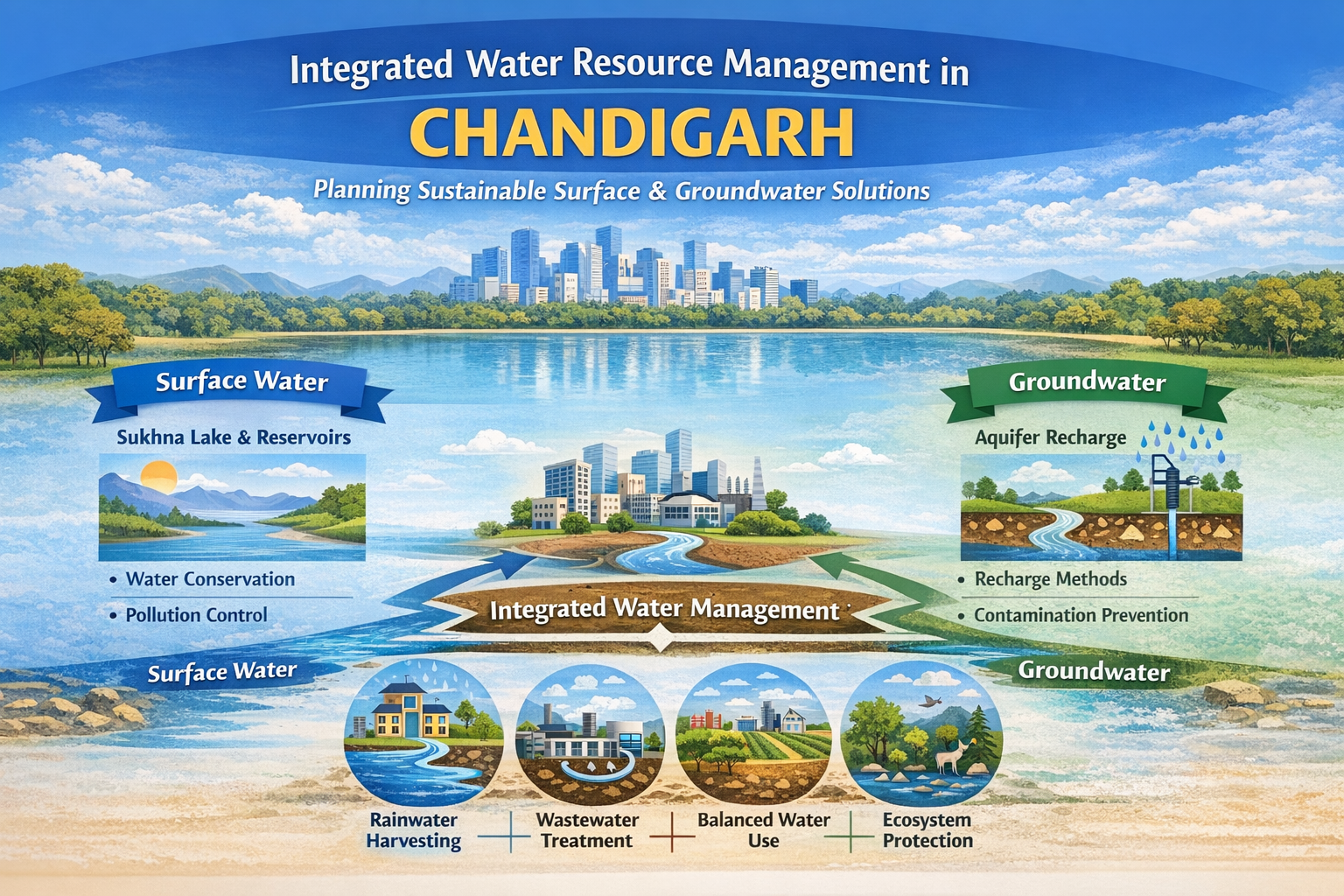
Integrated Water Resource Management in Chandigarh: Planning Sustainable Surface & Groundwater Solutions
While surface water plays a major role in Chandigarh’s supply system, groundwater remains a critical fallback resource during peak demand periods, maintenance shutdowns, and dry seasons. However, the city’s geology places clear limits on how groundwater can be safely used.
Chandigarh primarily sits over shallow alluvial aquifers with moderate storage capacity. These aquifers recharge mainly through rainfall infiltration and limited natural percolation zones. As urbanisation increases, recharge areas shrink, making groundwater planning a sensitive and location-specific requirement within integrated water resource management in Chandigarh.
Key groundwater requirements that must be addressed through integrated planning include:
-
Controlled groundwater extraction to prevent long-term decline
-
Identification and protection of natural recharge corridors
-
Sector-wise monitoring of groundwater levels
-
Integration of recharge planning within urban infrastructure
Ignoring these factors leads to gradual aquifer stress — a risk that often goes unnoticed until recovery becomes difficult.
Groundwater Stress Zones Within the Urban Landscape
Not all parts of Chandigarh face the same groundwater conditions. Sector-wise development density, land use patterns, and drainage characteristics create uneven groundwater behaviour across the city.
In high-density residential and institutional zones:
-
Groundwater recharge is limited due to paved surfaces
-
Stormwater is quickly drained away instead of infiltrating
-
Dependence on groundwater increases during summer months
In contrast, peripheral and green-buffer areas still offer opportunities for recharge, provided they are identified and protected early.
Integrated water resource management services in Chandigarh account for these variations, ensuring that groundwater planning is not treated as a one-size-fits-all solution.
Caution: Over-Reliance on Groundwater in a Planned City
One of the biggest misconceptions is that a well-planned city automatically has sustainable water systems. In reality, planned infrastructure does not guarantee sustainable groundwater use.
In Chandigarh, over-reliance on groundwater can result in:
-
Gradual lowering of water tables
-
Reduced well yields over time
-
Increased pumping costs
-
Risk of groundwater quality deterioration
These risks make it essential to integrate groundwater planning with surface water availability, stormwater management, and land-use decisions — the core philosophy of integrated surface and groundwater management.
Importance of Recharge-Centric Planning in Chandigarh
Recharge is the backbone of sustainable groundwater use, yet it is often overlooked in urban water strategies. In Chandigarh’s context, recharge planning must be intentional and scientifically guided.
Recharge-centric strategies within water resource management planning in Chandigarh focus on:
-
Capturing monsoon runoff before it leaves the city
-
Enhancing infiltration in open spaces and green belts
-
Aligning drainage design with recharge potential
-
Preventing encroachment on natural percolation zones
When recharge is planned alongside supply, groundwater becomes a resilient resource rather than a stressed one.
-> Checkout for more information about groundwater: GWP-CEE National Water Policy – 2012Integrating Urban Growth With Water Availability
Chandigarh continues to evolve — through institutional expansion, commercial development, and regional integration with Mohali and Panchkula. Each new development adds pressure to existing water systems.
Urban water resource management in Chandigarh must therefore answer a critical question before approving growth:
Can the city’s surface and groundwater systems sustainably support this demand?
Integrated water planning provides this answer by linking:
-
Demand forecasting
-
Surface water allocation
-
Groundwater availability
-
Recharge feasibility
This approach prevents short-term planning decisions from creating long-term water insecurity.
Regional Coordination Across the Tricity
Water does not follow administrative boundaries. Chandigarh’s groundwater and surface water systems are hydrologically connected with surrounding regions.
Without coordinated planning:
-
Over-extraction in one area affects neighbouring zones
-
Recharge efforts lose effectiveness
-
Surface water stress is transferred rather than reduced
This makes sustainable water management in Chandigarh inseparable from regional water planning across the Tricity.
Why Integrated Water Resource Management Is the Only Viable Path
Fragmented water decisions may solve immediate issues, but they quietly accumulate long-term risks. Chandigarh’s geography, limited recharge capacity, and growing demand leave little room for error.
Integrated Water Resource Management in Chandigarh provides:
-
Scientific understanding of groundwater behaviour
-
Balanced use of surface and subsurface resources
-
Data-backed planning for urban growth
-
Long-term resilience against climate variability
For projects that require a technically sound and region-specific approach, Integrated Water Resource Management services available at
https://thegroundwatercompany.com/integrated-water-resource-management/
support sustainable planning by aligning groundwater requirements, surface water systems, and urban development.
Planning Water Sustainability With Responsibility
Chandigarh’s water future depends not on how much water is extracted, but on how intelligently it is planned and protected. Groundwater must be treated as a strategic reserve, surface water as a managed asset, and urban growth as a responsibility.
By adopting integrated water resource management in Chandigarh, the city can protect its aquifers, optimise surface water use, and build a resilient foundation for future generations.
FAQ
Integrated Water Resource Management (IWRM) is a planning approach that coordinates the use of surface water, groundwater, stormwater, and land resources to ensure long-term water sustainability. Instead of managing each source separately, IWRM considers the entire water cycle, environmental limits, and future demand together.
Chandigarh has limited groundwater recharge capacity due to shallow alluvial aquifers and increasing urbanisation. Integrated Water Resource Management helps balance surface water supply, groundwater usage, recharge planning, and urban growth, reducing long-term water stress and preventing aquifer degradation.
Groundwater acts as a strategic reserve within IWRM. In Chandigarh, it supports water supply during peak demand, dry seasons, and maintenance periods. Integrated planning ensures groundwater extraction remains controlled, monitored, and supported by recharge measures to avoid long-term depletion.
Key challenges include:
Shrinking natural recharge zones due to urban development
Uneven groundwater behaviour across city sectors
Over-reliance on groundwater during summer months
Limited scope for natural infiltration in paved areas
Integrated planning addresses these challenges by aligning infrastructure design with hydrological realities.
Recharge planning ensures that rainfall and stormwater are retained and infiltrated locally instead of being drained out of the city. In Chandigarh, recharge-centric planning focuses on protecting green belts, improving infiltration in open spaces, and integrating recharge features into urban infrastructure.
No. While cities like Chandigarh face complex water challenges, IWRM is equally important for urban extensions, institutional campuses, industrial zones, and regional planning authorities. Any area dependent on both surface and groundwater benefits from integrated water planning.
IWRM studies are commonly required for:
Urban development authorities
Infrastructure and institutional projects
Large residential or commercial developments
Regional planning bodies
These studies support sustainable decision-making and regulatory compliance.